
Dental implants
A dental implant replaces the root of a missing tooth. Once it has healed into the bone, it supports a crown, a bridge or a denture. Dr. Azadi plans, places and restores implants here in our office, using Straumann® implants.
What it is
A dental implant is a small, screw-shaped post placed in the jawbone to replace the root of a missing tooth. Once it has healed, it can support a crown, a bridge or a denture.
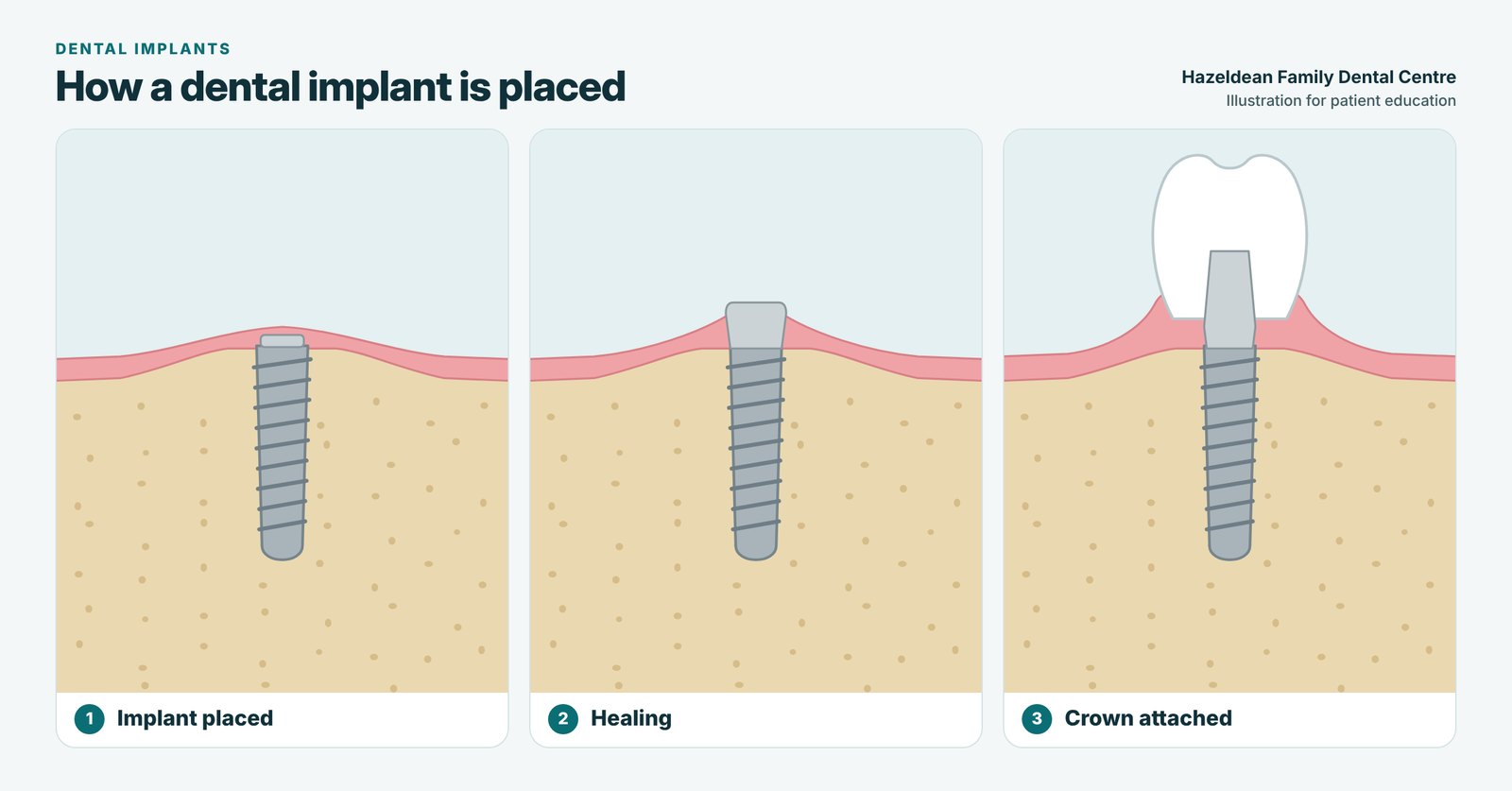
The three parts of an implant
- Implant
- A small post, usually titanium or a titanium alloy, placed in the jawbone. It acts as the new tooth root.
- Abutment
- A connector that attaches to the implant and holds the final tooth.
- Crown
- The visible, custom-made tooth, shaded to blend in with your natural teeth.
Over the following weeks to months, the bone bonds to the implant surface. This process, called osseointegration, is what makes an implant stable.
Why replace a missing tooth?
A gap affects more than your smile. Over time, a missing tooth can lead to:
- Bone loss
- Without a tooth root, the jawbone in the gap gradually shrinks.
- Shifting teeth
- Neighbouring teeth can tilt into the space, and the opposing tooth can over-erupt.
- Bite and chewing problems
- Uneven forces can strain your remaining teeth.
- Harder cleaning
- Tilted teeth and new gaps can trap food and plaque.
- Changes in appearance
- Bone loss can reduce facial support, especially when several teeth are missing.
Why choose an implant?
- Looks, feels and functions much like a natural tooth
- No need to reshape healthy neighbouring teeth, as a traditional bridge requires
- Helps preserve the jawbone by replacing the tooth root
- Stable, with no slipping or adhesives, unlike removable dentures
- With good care and regular check-ups, implants can last many years
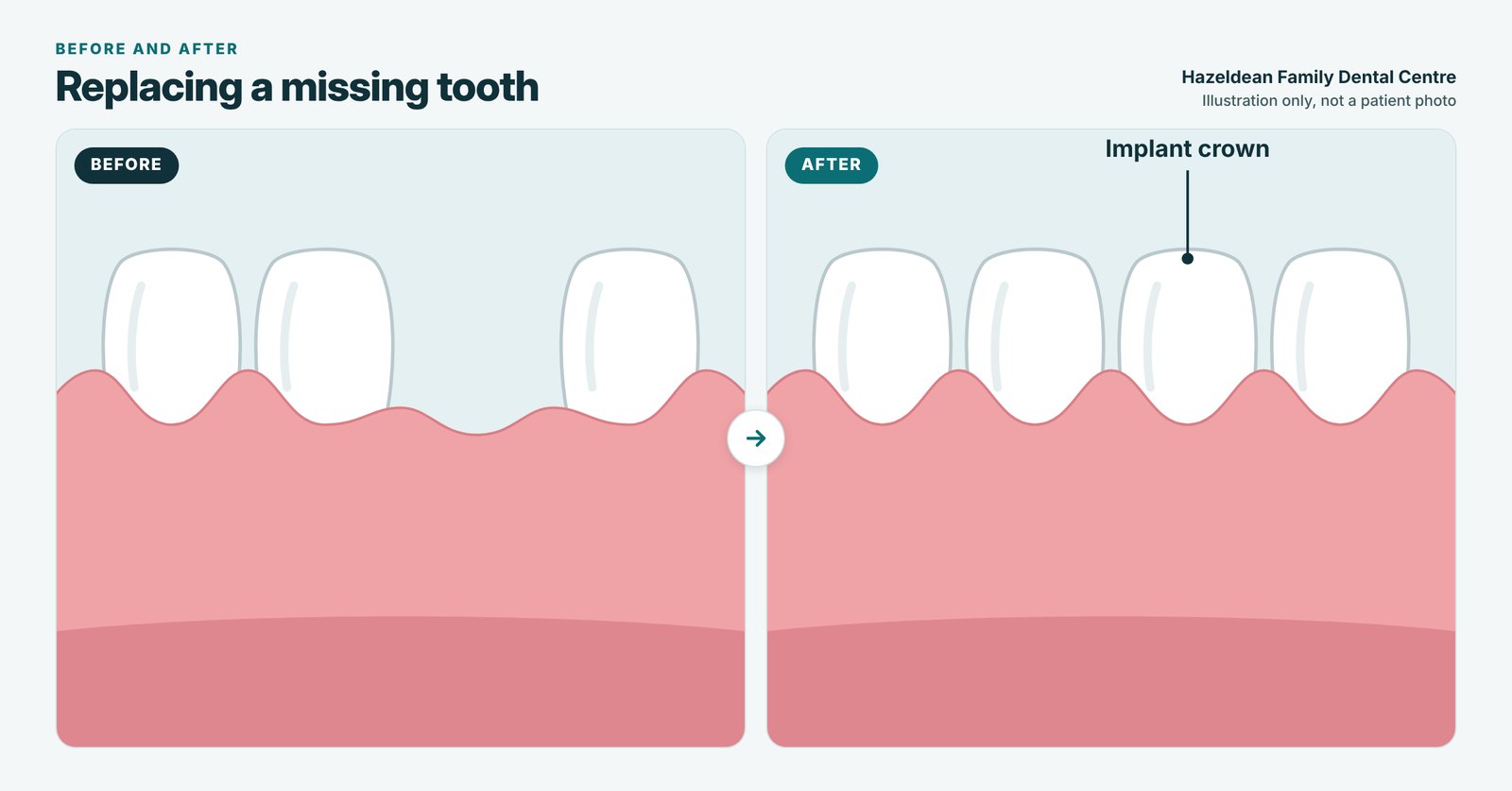
Implant options
- Single tooth
- One implant supports one crown.
- Implant bridge
- Two or more implants support several teeth in a row, without relying on your natural teeth.
- Implant-retained denture
- A removable denture snaps onto implants for a secure fit.
- Full-arch fixed teeth
- A fixed set of teeth is anchored on several implants.
When the bone or gum needs help first
Some patients first need an extraction, gum treatment or bone grafting. We provide extractions with socket preservation, bone grafting, and gum grafting around implants, so the whole treatment can usually happen in one place.
Is an implant right for you?
Most adults with missing teeth can be considered. Your dentist will review the things that affect healing and long-term success, including:
- Gum health (active gum disease is treated first)
- The amount and quality of bone, which grafting may improve
- Smoking or vaping
- Uncontrolled diabetes or other medical conditions
- Some medications, such as certain osteoporosis or cancer drugs
- Past radiation therapy to the head or neck
- Heavy clenching or grinding
Your treatment journey
- ConsultationWe examine your mouth, review your health history, and take x-rays, plus a 3D (CBCT) scan when needed, to assess the bone.
- PlanningWe plan the implant position and go over your options, timing and costs. Some patients first need an extraction, gum treatment or bone grafting.
- Implant placementThe implant is placed under freezing (local anaesthetic), usually in a single visit.
- HealingThe bone bonds to the implant, typically over several weeks to a few months. A temporary tooth may be possible in the meantime.
- Final toothOnce healed, the abutment and your custom crown, bridge or denture are attached.
- MaintenanceRegular check-ups and cleanings keep your implant and the gum around it healthy.
Timelines vary. Treatment often takes a few months from start to finish, and longer if bone grafting is needed. In selected cases, an implant can be placed right after a tooth is removed.
Possible risks
As with any surgery, there are risks. Your dentist will go over the ones that apply to you:
- Pain, swelling, bruising or bleeding after surgery
- Infection around the implant
- Numbness from nerve irritation, usually temporary
- Sinus involvement for implants in the upper back jaw
- The implant not bonding to the bone and needing to be replaced
- Long-term inflammation of the gum and bone around the implant (peri-implantitis)
After surgery and long-term care
- Some swelling, bruising and tenderness is common for a few days.
- Eat soft foods and avoid chewing on the area as directed.
- Avoid smoking, which slows healing and raises the risk of implant problems.
- Call us if you have heavy bleeding, a fever, or pain that gets worse instead of better.
Caring for your implant
- Brush twice a day and clean between your teeth daily.
- Keep your regular check-ups and professional cleanings.
- Implants can't get cavities, but the gum and bone around them can become inflamed if plaque builds up.
- Wear a night guard if you clench or grind.
Questions to ask at your consultation
- Am I a good candidate for an implant?
- Will I need bone grafting or other treatment first?
- Which option suits me: a single implant, a bridge or a denture?
- How long will the whole process take?
- Will I have a temporary tooth while I heal?
- What will it cost, and what might insurance cover?
- What are my alternatives, and their pros and cons?
- How should I care for my implant long term?
Take it home: our printable patient guide, Understanding Dental Implants.
Open the guide (PDF)Common questions
Does getting an implant hurt?
The area is frozen, so during placement most people feel pressure rather than pain. Afterwards, soreness is usually similar to having a tooth out and is managed with over-the-counter pain relief. We'll tell you what to take for your situation.
How long does the whole process take?
Often a few months from start to finish, and longer if a tooth has to be removed first or bone grafting is needed. Your plan will include a timeline.
Will I have a gap while it heals?
Usually not. Depending on where the implant is, we can make a temporary tooth, a small removable partial, or adjust your existing denture.
Does insurance cover implants?
Coverage varies a lot between plans. We can send a predetermination to your insurer so you know your share before treatment starts.
Am I too old for implants?
Age alone usually isn't the deciding factor; your general health and bone are. Many older adults have implants placed, often to hold a lower denture steady.
Dr. Anahita Azadi Boroujeni, DDS, Dr. Cynthia Simon, DMD, and Dr. Kyra de Gouw, DMD, are general dentists registered with the Royal College of Dental Surgeons of Ontario. This page is general information. Your treatment is planned after an examination.